
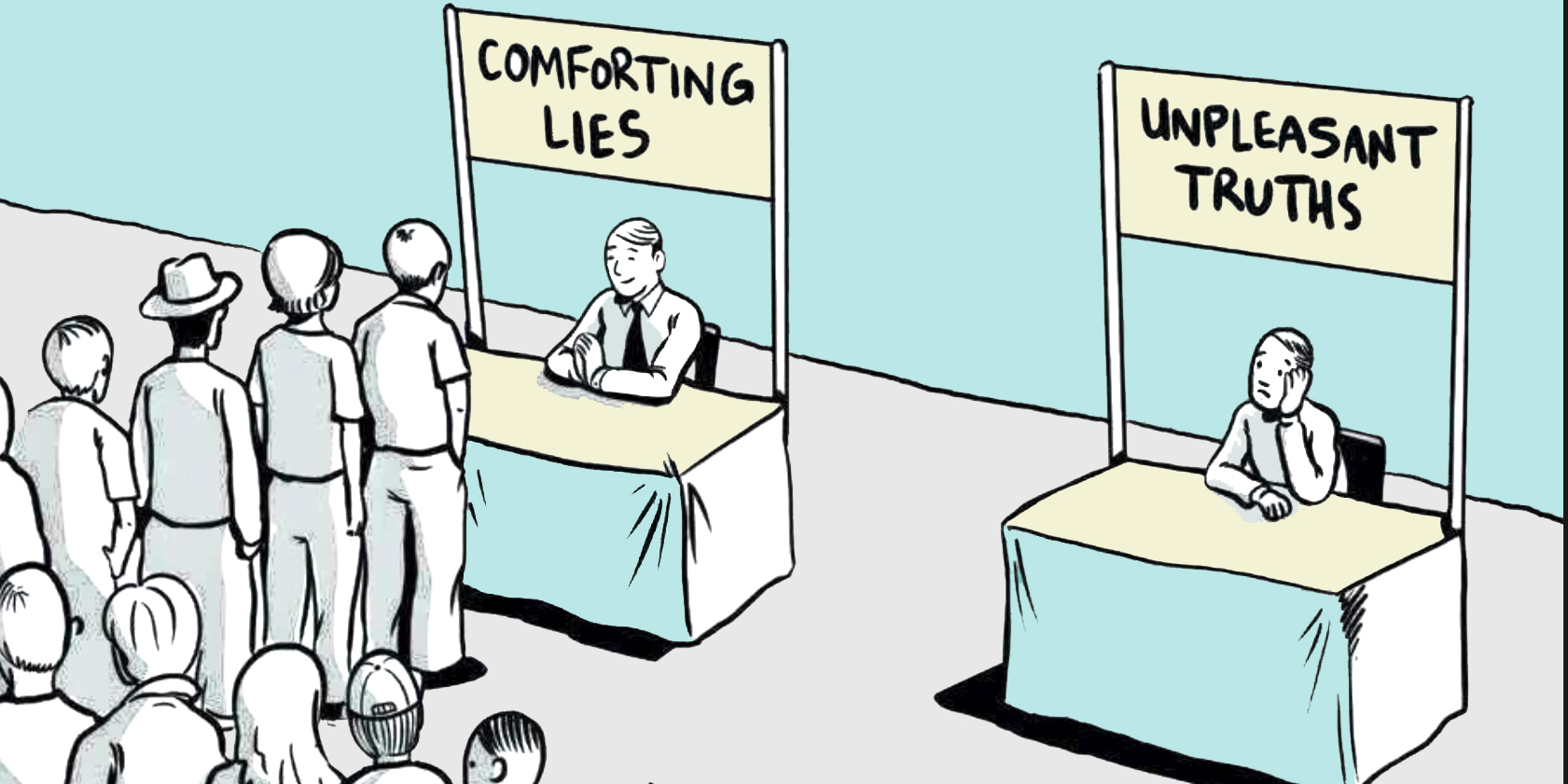
Confirmation bias is one of the most subtle blind spots in decision-making — where we don’t see the truth as it is, but only as we’ve already believed it to be. Let’s dive into the full picture of this powerful psychological effect.
What Is Confirmation Bias?

A simple example of confirmation bias: people tend to pay more attention to information that supports their existing beliefs, while ignoring or downplaying evidence that contradicts them.
Confirmation bias is a common cognitive distortion, where we are more likely to accept and trust information that aligns with our pre-existing views—while dismissing or undervaluing opposing data.
In practice, this means we often seek out, remember, and interpret information in ways that reinforce what we already believe—without realizing we’re “filtering” reality to fit our personal thinking.
Confirmation bias is so widespread that it has been called “the most well-known and widely accepted cognitive error”in human reasoning. It is also a root cause of other cognitive effects, such as cherry-picking data, in-group favoritism, and one-sided thinking.
Put simply, once we form a belief or hypothesis, we naturally look for information that supports it—and avoid or reject evidence that challenges it.
For example, someone with strong political views may focus on articles that align with their stance, while skimming past or rationalizing away those from the opposing side.
Over time, this one-sided intake of information leads to more extreme and rigid beliefs, as the person accumulates supporting evidence but lacks balanced exposure to other viewpoints.
Confirmation bias can occur in all areas of life and affects everyone—even experts. Seasoned scientists and experienced doctors are not immune.
Why Understanding Confirmation Bias Matters
Understanding confirmation bias is crucial because it helps us:
- Avoid one of the most common thinking errors in human cognition.
- Form more accurate beliefs by considering the full range of evidence.
- Make wiser decisions based on reality, not assumptions.
- Engage in healthier discussions with less extremism and more openness.
This awareness is also a key part of metacognition—the ability to “think about how we think”—which is a cornerstone of genuine critical thinking.
By actively recognizing confirmation bias, we increase our chances of getting closer to the truth and making better judgments in an increasingly complex world.
Why Does Confirmation Bias Happen?

Psychologists have identified a range of cognitive mechanisms and motivational factors behind confirmation bias. Simply put, it stems from how our brain simplifies information and protects existing beliefs. Key contributing factors include:
1/Cognitive Efficiency & Information Overload
The human brain constantly processes far more information than it can deeply absorb. Favoring what already fits our beliefs is a mental shortcut that conserves energy—it’s much easier than re-evaluating everything from scratch.
Quickly filtering out conflicting information reduces cognitive load and helps prevent “analysis paralysis.” From an evolutionary perspective, making fast decisions based on familiar patterns—while not always accurate—may have helped our ancestors survive.
But this “fast and frugal” processing comes at the cost of systematic bias.
2/Selective Attention, Biased Interpretation & Skewed Memory
Confirmation bias shows up in multiple mental processes. We tend to:
- Seek out information that supports our existing views (e.g., only reading news we agree with)
- Interpret ambiguous data in a way that confirms our assumptions
- Remember selectively: we recall evidence that supports our belief and forget what contradicts it
Research shows people can more easily generate and remember arguments that support their beliefs than those that oppose them. They only start considering opposing viewpoints when prompted directly.
3/Motivated Reasoning & Emotional Defensiveness
Sometimes, confirmation bias is not just about thinking—but about protecting the self. Admitting that a long-held belief is wrong can be psychologically painful, threatening our ego and self-esteem.
To avoid this discomfort (related to cognitive dissonance), we often rationalize or ignore evidence that proves us wrong. This is a defense mechanism to avoid the feeling of loss or failure.
The effect is even stronger when beliefs are tied to politics, religion, or personal values, because we identify with those beliefs—and thus distort reality to protect our sense of self.
4/Reasoning to Win, Not to Discover Truth
A striking theory suggests that human reasoning didn’t evolve to find truth, but to win arguments.
According to the Argumentative Theory of Reasoning (Mercier & Sperber, 2011), logical reasoning developed to aid social communication and group coordination. In that context, the brain’s priority is to build strong arguments for what it already believes, not to neutrally evaluate all evidence.
“A skilled debater isn’t seeking truth—they’re seeking justification.”
That’s why our reasoning is often geared toward confirming our views and countering disagreement—because this once helped us influence others and maintain group cohesion.
This makes confirmation bias deeply rooted and hard to eliminate—it may be built into the original function of reason itself.
Adaptive Value and Survival Function
Some researchers argue that confirmation bias may have had adaptive benefits in uncertain or dangerous environments.
If you suspect a plant is poisonous, it’s safer to focus on confirming danger (and ignore exceptions) than to risk your life testing alternatives.
But in modern life, this tendency can easily go overboard—making people rigid, defensive, and closed-minded, even when openness would be more beneficial.
Conclusion
Confirmation bias arises from a mix of cognitive shortcuts (to process information efficiently) and motivated reasoning(to protect beliefs and the self).
Once a belief forms, the mind tends to interpret everything else as evidence supporting it.
As Francis Bacon observed in 1620:
“Once the human mind has adopted an opinion… it draws everything else to support and confirm it, while ignoring or discounting anything to the contrary.”
That insight captured the deep nature of confirmation bias—and why it continues to shape our thinking centuries later.
Impact on Individual, Group, and Societal Decision-Making

Confirmation bias can seriously distort judgment at both personal and collective levels, often leading to negative consequences.
It introduces systemic errors in decision-making, weakening our ability to assess situations objectively and make rational choices—whether as individuals or as organizations.
By ignoring opposing views, individuals and groups become more prone to poor decisions—from everyday mistakes to serious strategic misjudgments.
Recognizing confirmation bias is the first step toward overcoming it, helping us think more clearly and make better decisions.
Individual Level
Overconfidence and Poor Judgment
At a personal level, confirmation bias leads people to become overconfident in their beliefs, even when lacking objective evidence.
For example, someone might collect plenty of “evidence” supporting their preferred investment strategy, medical treatment, or conspiracy theory—while unconsciously filtering out contradictory facts.
This can cause them to stick with flawed decisions or take excessive risks.
An investor convinced that a stock will rise may ignore warning signs in the company’s financials, resulting in major losses.
In severe cases, confirmation bias is considered a contributing factor to disasters or “black swan” events—where decision-makers overlook warning signs simply because they don’t fit their expectations.
Example: The 2008 financial crisis was partly due to regulators and banks ignoring the risks in the housing market, believing that “home prices couldn’t collapse all at once.” In hindsight, many red flags had been visible—but were dismissed because they clashed with prior beliefs.
Group Level
Groupthink and Polarization
In group settings, confirmation bias contributes to groupthink—where the desire for harmony or consensus leads people to suppress or ignore dissenting opinions.
This collective bias causes the group to acknowledge only information that reinforces the leader’s or majority’s viewpoint.
Case in point: The 1986 Challenger space shuttle disaster. NASA officials disregarded technical warnings about cold temperatures because they conflicted with the assumption that the launch would proceed normally.
Another common outcome is group polarization.
When like-minded individuals discuss an issue, their views tend to grow even more extreme. Members mostly share information that supports the group’s initial direction, while ambiguous evidence is interpreted in a favorable light. Contradictory data is either dismissed or seen as an exception.
Example: In mock jury studies, if most members initially favor a lenient sentence, the final decision becomes even more lenient after group discussion. The opposite happens with groups leaning toward harsher punishment.
On social media, group polarization happens in echo chambers—communities where only reinforcing opinions are heard, neutral voices are drowned out, and extreme views are amplified through mutual validation.
Societal Level
Fragmented Realities and Misinformation
At the societal level, confirmation bias contributes to division and misinformation.
When different groups live in their own “information bubbles,” each side constructs a separate version of reality, making even basic truths hard to agree upon.
This obstructs dialogue, stalls public debate, and even disrupts scientific consensus—on topics like climate change or public health—because each group only trusts sources that align with their beliefs.
Society risks becoming split into “parallel worlds”, which can be easily exploited by bad actors spreading disinformation targeted at vulnerable audiences.
Conspiracy theories are a prime example: believers easily accept anything that supports the theory, while dismissing counter-evidence as part of “the cover-up”—creating a self-reinforcing belief loop that is nearly unbreakable.
In organizational culture, if leaders discourage dissent or debate, a “yes-man culture” can form—where only positive news gets passed upward, and flawed policies persist unchecked.
Historical example: The Bay of Pigs invasion is a textbook case of groupthink and confirmation bias. Advisors hesitated to challenge leadership, leading to overly optimistic planning and a major failure.
Strategies to Reduce and Overcome Confirmation Bias

There’s no perfect solution, but combining several of the strategies below can significantly reduce the effects of confirmation bias.
In a product team, for example, you can:
- Begin with open-ended brainstorming to avoid locking into one idea too soon.
- Test multiple prototypes to gather neutral feedback.
- Invite outside teams to review results.
- Conduct a premortem before launching.
At the individual level, you can regularly ask yourself:
“What would convince me that I’m wrong?”
It’s a simple yet powerful question that encourages fairer and more accurate thinking.
Since confirmation bias is deeply rooted in human thought, eliminating it entirely is extremely difficult. However, psychology and behavioral science offer many practical strategies to reduce its influence and improve decision-making. Here are some of the most effective ones:
Actively Seek Disconfirming Evidence (“Consider the Opposite”)
Develop the habit of asking:
“What evidence would disprove my belief?”
Make a conscious effort to expose yourself to opposing perspectives—like reading well-argued articles from different viewpoints.
Studies show that when people are asked to argue against their own beliefs, they can do it—and become more objective as a result.
In science, this is the foundation of falsification thinking: actively attempting to disprove a hypothesis rather than just confirm it.
Ask Neutral, Open-Ended Questions
The way we frame questions can steer the answers or open up broader insight.
If you suspect users find a menu confusing, avoid asking:
“Is the navigation menu hard to use?”
This type of leading question invites confirmation.
Instead, ask:
“How did you feel using the menu?” or
“Was there any part you found confusing?”
Neutral phrasing leads to more balanced feedback, avoiding the confirmation trap.
Play the Devil’s Advocate (or Assign One)
In team discussions, assign someone to act as a devil’s advocate—tasked with challenging assumptions and presenting counter-arguments, even if they don’t personally disagree.
This forces the group to consider hidden risks and avoids groupthink. Some organizations rotate this role or invite external experts to critique plans.
Use Structured Analysis Techniques
Many decision-making tools are designed to counter confirmation bias, such as:
- Red Teaming: An independent team challenges the main plan
- Premortem: Imagine the project has failed and ask: “What caused it to fail?”
- Multiple Hypotheses: Evaluate several ideas side by side, rather than focusing on just one
Decision matrices, blind evaluations, and standardized criteria also help reduce biased interpretation.
Increase Awareness and Education
Sometimes just knowing about confirmation bias helps us better control it.
For instance, if you catch yourself thinking, “Maybe I’m only listening to what I want to hear,” you can pause and reassess more carefully.
Some people create personal rules like:
“If I strongly believe in A, I must read at least one credible source that argues B.”
Critical thinking education—whether for students, doctors, or judges—often emphasizes challenging initial conclusions.
Slow Down Decisions and Use Decision Aids
Because confirmation bias is linked to fast, intuitive thinking, slowing down helps.
Avoid rushing important decisions. Use checklists or decision tools that force you to consider all options.
For example, doctors can use diagnostic checklists to rule out alternative illnesses before making a final call.
In daily life, “sleeping on it” helps you notice key facts you may have missed at first.
Embrace Diversity of People and Perspectives
Homogeneous groups (same background, beliefs, or expertise) are more prone to collective confirmation bias.
Diverse perspectives increase the chance of spotting blind spots and challenging assumptions.
But diversity only works when paired with a culture of openness, where disagreement is welcomed—not penalized.
Rely on Data and Test Assumptions
Apply a scientific mindset to business and life: treat beliefs as hypotheses to be tested, not truths to be defended.
Example: Instead of assuming “Feature Y will increase engagement,” run an A/B test—don’t just gather praise from those who already support it.
Set clear criteria before analyzing data to avoid cherry-picking convenient results.
Confirmation Bias in Real Life

Confirmation bias appears in nearly every area of life:
- In politics and media, it fuels polarization.
- In personal relationships, it distorts how we perceive others.
- In business, it leads to strategic and hiring mistakes.
- In science, it obstructs the search for truth.
- In education, it limits independent thinking.
The common thread: we tend to see only what we already believe.
Understanding this bias is the first step to overcoming it. Below are key real-world examples and fields where confirmation bias frequently occurs.
Politics and Media
In politics, confirmation bias contributes to polarization and the rise of echo chambers. People tend to follow media sources and social accounts that align with their beliefs—while ignoring dissenting voices.
For instance, you might scroll past a post from someone with opposing views, but eagerly read one from someone you agree with. Over time, platforms like Facebook or Twitter learn your preferences and keep feeding you similar content, reinforcing your perspective.
This creates a self-reinforcing feedback loop: the more you engage with confirming content, the more you get fed, making your beliefs stronger and more rigid.
A classic study (Lord, Ross & Lepper, 1979) showed that when people reviewed the same data about the death penalty, both supporters and opponents rated the evidence that supported their stance as more credible, and dismissed the opposing side—a phenomenon called attitude polarization.
In the modern media landscape, the situation is worse. Liberals read liberal news, conservatives read conservative news—and both feel they’re right. The concept of the “filter bubble” captures this well: the internet isolates us into ideological silos, reinforcing what we already believe.
Personal Relationships
In daily life, confirmation bias can distort understanding and reinforce prejudice. Once you’ve formed an impression of someone, you tend to notice behaviors that confirm that impression—while ignoring the rest.
Example: If you think a new colleague is “cold,” you may interpret their quietness in meetings as aloofness, while overlooking times they were friendly or helpful.
In romantic relationships, if someone believes their partner is “uncaring,” they’ll focus on late arrivals or missed chores—while overlooking caring gestures. This can lead to a self-fulfilling prophecy, where one treats the other based on negative expectations, and the partner responds accordingly—strengthening the bias.
Confirmation bias also reinforces intergroup prejudice.
If you believe “Group X is dishonest,” you’ll focus on scandals involving a few individuals, while ignoring countless honest actions—fueling division and conflict.
Business, Workplace, and Hiring
In business, confirmation bias can affect critical decisions, from strategy to hiring.
Example: A CEO strongly believes a new product will succeed. They hire a market research team—but unknowingly steer the research toward confirming their belief.
The team, aware of what the CEO wants, designs questions likely to yield positive responses.
The report confirms the CEO’s “gut feeling,” the product launches—and fails, because warning signs were ignored.
The same happens in hiring.
If a recruiter forms a good impression early (perhaps due to shared interests), they may ask softer questions, emphasize strengths, and recall the interview more positively—confirming the initial bias.
The opposite occurs with poor first impressions.
Many companies now use structured interviews and blind resume reviews to reduce bias in hiring decisions.
Science and Data Analysis
Even in science—which values objectivity—confirmation bias can be subtle and pervasive.
Scientists are human too. They may design experiments or interpret data in ways that support their preferred hypothesis.
They might only publish favorable results and ignore contradictory ones—a problem known as the file drawer effect.
A common issue: stopping data collection early once results appear to support a theory.
Another is HARKing (Hypothesizing After Results are Known), where researchers create a hypothesis after seeing the data—cherry-picking patterns and ignoring contradictory evidence.
Even in medicine, doctors may rush to confirm an initial diagnosis, overlooking symptoms pointing to a different illness.
As philosopher Karl Popper noted, science advances not by confirming hypotheses, but by attempting to falsify them.
This is why peer review, replication, and data transparency are essential tools to guard against bias in science.
Education and Learning
In education, confirmation bias can affect both teachers and students.
Teachers may form early impressions of students (e.g., “This student is weak in math”) and pay more attention to errors than improvements—creating a self-fulfilling expectation (known as the Pygmalion Effect).
Students can also internalize bias:
If they believe “I’m bad at math,” they’ll interpret every difficult problem as proof—while ignoring successful attempts.
When writing essays or conducting research, students often select sources that support their pre-decided opinion, rather than exploring opposing viewpoints.
Teaching critical thinking and scientific reasoning can help students recognize and counter confirmation bias, leading to broader understanding and better judgment.
UX Design and Product Development
Confirmation bias has a significant impact on product development, user experience (UX) design, and customer feedback analysis.
When product teams fall into this bias, they become overly attached to early assumptions, misunderstanding user needs and creating suboptimal products.
Example: A UX team has spent months designing a new interface they love.
Because of this emotional investment, they’re more likely to value positive feedback (which confirms their design is “good”) and dismiss negative input as “user error” or “edge cases.”
In contrast, if the team had only sketched a quick paper prototype, they’d be less emotionally attached and more open to critical feedback.
Lesson learned:
The more time and effort you invest in an idea, the stronger your confirmation bias becomes.
Ego and sunk costs become tied to the design—causing the team to unconsciously filter research results to protect the original assumption.
In UX research:
When researchers ask leading questions, they often receive confirmation—not discovery.
Example: If an e-commerce site isn’t converting and the team suspects the “Buy Now” button is hard to find, they might ask:
“Did you find the red checkout button hard to see?”
This question:
- Implies there’s a problem
- Focuses attention on the red button
- Nudges the user toward confirming a problem—even if it’s not the real issue
As a result, the team may focus all efforts on redesigning the button—while the real problem might be shipping costs or page load speed, which were never brought up.
A better question would be:
“How was your checkout experience?”
or
“Was anything confusing or frustrating during your purchase?”
Open-ended questions allow users to surface real issues, not just confirm designer assumptions.
In product analytics:
Confirmation bias can also distort how teams read and interpret metrics.
Example: A PM believes a new feature will increase engagement.
After launch, they focus on supporting metrics (e.g., session time increases for one segment) and ignore contradictory data (like retention staying flat or declining).
Prematurely declaring success based on selective metrics is a clear sign of confirmation bias.
How to reduce this:
- Define success criteria before running experiments
- Use rigorous statistical methods
- Establish guardrails to prevent data distortion for the sake of confirming assumptions
The Historical Context of Confirmation Bias
While scientific understanding of confirmation bias is relatively recent, the challenge it poses to truth-seeking has been recognized for centuries.
The tendency for people to favor evidence that confirms what they already believe is not new—observers of human behavior have documented this phenomenon long before it had a formal name.
One of the earliest and most striking descriptions comes from Francis Bacon, in his 1620 work Novum Organum. He observed:
Once the human mind has adopted an opinion, it tends to seek out confirming evidence and “ignores or discounts contrary instances.”
Bacon illustrated this with a sharp example:
In a temple where people prayed for safety at sea, only the names of survivors were displayed—as proof of divine protection. But no one asked:
“What about those who prayed and still drowned?”
This is a clear early articulation of “remembering the hits, ignoring the misses”—a form of confirmation bias, even though the term didn’t yet exist.
Bacon viewed this tendency as a major obstacle to objective knowledge, which he called one of the “Idols of the Mind.” His proposed solution was a proto-scientific method: careful, empirical observation and reasoning rooted in evidence—not assumptions.
From Philosophical Intuition to Experimental Psychology
Although described philosophically centuries ago, confirmation bias was only systematically studied in psychology during the mid-20th century, as part of the cognitive revolution.
The term “confirmation bias” was coined by British psychologist Peter Cathcart Wason in the 1960s.
He devised a series of clever experiments to examine how people test hypotheses. The most famous is the 2-4-6 task: participants were shown the sequence “2, 4, 6” and asked to identify the underlying rule.
Most assumed the rule was “increasing by two” and tested it by proposing sequences like “8-10-12” or “10-12-14.”
But few tried sequences that could disprove their theory, such as “2-4-5.”
As a result, they failed to discover the actual rule, which was simply “any ascending sequence.”
Wason concluded that people tend to seek confirmation rather than falsification of their beliefs.
He also created the famous Wason Selection Task with four cards, which revealed that people prefer to test rules by seeking confirmation rather than by looking for counterexamples
Expansion of Cognitive Bias Research
From the 1970s to 1980s, research on cognitive biases exploded, thanks to psychologists like Amos Tversky, Daniel Kahneman, and others.
Confirmation bias emerged as one of the central biases, contributing to:
- Belief perseverance: holding on to beliefs even after disconfirming evidence
- Attitude polarization: when mixed evidence strengthens rather than weakens prior views
A landmark 1979 study by Lord, Ross, and Lepper demonstrated that people presented with mixed scientific evidence on capital punishment found the evidence that supported their view more credible, while dismissing the opposing data.
Psychologist Lee Ross summarized this phenomenon:
“Beliefs can survive even after the evidence for them has been discredited.”
In 1998, Raymond Nickerson published a highly influential review titled
“Confirmation Bias: A Ubiquitous Phenomenon in Many Guises.”
He described confirmation bias as a cluster of interrelated effects—including biased searching, interpretation, and memory—all driven by a tendency to favor existing beliefs.
Modern Applications: From Technology to Cross-Disciplinary Research
In recent decades, confirmation bias has become central to interdisciplinary studies, especially in areas like:
- Media technology and personalization algorithms
- Media psychology and political communication
- Artificial intelligence, forensic science, intelligence analysis, and medical diagnostics
The rise of social media and personalized content algorithms has made it urgent to understand and mitigate confirmation bias, as technology can now amplify this bias at an unprecedented scale.
Media researchers like Rich Ling (2020) have identified confirmation bias as a major driver of fake news and online echo chambers.
Today, the concept of confirmation bias is widely taught in:
- Psychology and critical thinking courses
- Corporate training programs (e.g., decision-making, hiring, DEI initiatives)
- Popular media and public discourse
It is also being actively applied in professional fields:
- Medical diagnosis: helping doctors avoid “anchoring” on the first diagnosis too quickly
- Forensic science: avoiding tunnel vision that focuses solely on evidence against an initial suspect
- National intelligence: following 9/11, agencies began training analysts to identify cognitive biases when assessing threats.
Final Thought

Confirmation bias is one of the most fundamental thinking traps in human cognition—a tendency to see only what we want to see, and to reinforce what we already believe.
It stems from the mind’s need for efficiency, consistency, and comfort, but can distort how we perceive reality.
In this overview, we’ve explored:
- The definition and underlying mechanisms of confirmation bias
- Real-world examples across diverse domains
- Its impact on personal decisions and group policies
- Strategies for reducing its influence
- Its significance in product design, AI, and the deeper evolutionary psychology behind it
We also saw that this bias was recognized centuries ago, long before modern psychology gave it a name or scientific framework.
Because critical thinking and sound judgment begin with recognizing our own blind spots.
Confirmation bias is often invisible while it’s happening, and to detect it, we need:
- Conscious effort
- Sometimes even external feedback
When we understand this bias, we learn to ask ourselves:
“Am I being objective—or just selecting evidence that supports what I already believe?”
This kind of self-questioning is the foundation of:
- Science
- Effective problem-solving
- Constructive dialogue
In an era of information overload and algorithmic filtering, the risk of being misled by confirmation bias has never been greater.
Yet we also have tools to fight back:
- The scientific method
- Critical thinking techniques
- Personal habits like curiosity and healthy skepticism
As individuals, we can:
- Proactively seek opposing viewpoints
- Be willing to change our beliefs when the evidence demands it
As teams, we can:
- Build a culture that values truth over consensus
- Encourage dissent and diverse perspectives
In media and technology, we can:
- Design platforms that expand our worldview, rather than trap users in confirmation bubbles
No one is entirely free from confirmation bias—it’s part of being human.
But when we become aware of it and choose to confront it, we can dramatically reduce its negative effects.
This empowers us to:
- Believe more accurately
- Decide more wisely
- Build a more open and understanding society
In the spirit of lifelong learning, confirmation bias reminds us to continually ask:
“Am I seeing the whole picture—or just what I want to see?”
The more often we ask this question, the closer we move toward genuine understanding.


